Start with the engineer in the system.
Engineering excellence means producing valuable, reliable software under uncertainty. It depends on individual capability, but also on the codebase, tooling, goals, management, team communication and organisational environment. A useful framework considers the engineer, the team and the wider engineering system together.
An exceptional engineer produces durable value under uncertainty and increases the capability of the system around them.
The framework separates four connected layers that are often mixed into one undifferentiated competency list. They are cumulative rather than interchangeable.
- Technical foundationsThe knowledge and practical ability required to build, operate and change the relevant systems safely.
- Judgement and executionThe ability to frame problems, reason about systems, make proportionate decisions and deliver useful outcomes.
- Team contributionThe ability to improve shared understanding, collaboration, conflict resolution and collective performance.
- Organisational leverageThe ability to improve standards, tools, structures and conditions so the wider system performs better.
Use the model to distinguish prerequisites that make work safe and reliable, differentiators that explain disproportionate positive impact, and contextual requirements that depend on the role, product and risk profile.
Define excellence in observable terms.
A useful capability model describes what good work looks like, what it changes and how failure shows up. It should not expect every engineer to demonstrate every capability at the same depth.
Technical foundations
Understands the relevant systems, makes sound technical trade-offs and changes them safely. Explains where their knowledge ends.
Problem framing
Finds the underlying problem, separates facts from assumptions and reduces the most important uncertainty first.
Systems thinking
Sees how a change affects customers, operations, cost, other systems and future decisions.
Design judgement
Chooses clear, maintainable solutions without unnecessary complexity and matches the design to the problem and risk.
Quality and risk
Sets an explicit quality bar, raises important risks early and uses review, testing, observability and release controls in proportion to the risk.
Communication
Explains complex ideas to different audiences, listens carefully and makes decisions, risks and uncertainty visible.
Collaboration
Shares knowledge, challenges ideas constructively, changes position when the evidence is stronger and commits after disagreement.
Ownership and outcomes
Takes initiative, exposes dependencies, follows through after release and keeps the outcome in view when the plan must change.
Learning agility
Seeks feedback, updates their judgement when the evidence changes and helps the team retain what was learned.
Humility, empathy and reliability
Understands colleagues and users, assesses their own confidence accurately, gives direct feedback and renegotiates commitments early.
Force multiplication
Reduces ambiguity, mentors others and improves how the team works so that more people can act independently.
Understand what sustains great work.
Pay, recognition and working conditions matter, but they are not enough on their own. People also need meaningful ownership, opportunities to improve, strong working relationships and a clear connection to why the work matters. Autonomy, Mastery and Purpose remain useful, but they are not a complete account of motivation.
Autonomy
Meaningful control over how work is approached, inside boundaries that make the outcome, risk and available support clear.
Mastery
Challenging but achievable work, timely feedback, strong peers and repeated opportunities to improve.
Purpose
A visible connection between engineering choices, user value, company direction and a responsibility worth serving.
Autonomy works when people have context, boundaries and support. Challenging work needs feedback and a credible chance of success. Purpose needs a visible link to users, the business or a responsibility the engineer believes is worth serving. When strong engineers disengage, examine the whole system: the work, opportunities, feedback, quality constraints, decision delays, workload, compensation and prospects for progression.
Recruit for evidence of how someone works.
Technical assessment is necessary, but coding puzzles alone reveal too little about how someone works inside a real product and team. Start with the outcomes, technical context and material risks of the role, then choose assessment methods that reveal the capabilities and judgement you actually need.
| Method | Primary evidence | Design requirement |
|---|---|---|
| Structured experience interview | Ownership, learning, judgement, collaboration and consequences. | Ask the same core questions and score against anchored criteria. |
| Work sample | Role-relevant technical execution, problem framing and quality. | Use realistic scope, explicit constraints and proportionate time. |
| Design or incident scenario | Systems thinking, trade-offs, risk and communication. | Allow clarification and assess reasoning rather than hidden trivia. |
| Collaborative review | Response to feedback, disagreement and shared problem-solving. | Use trained assessors and clear signals; avoid rewarding rehearsed performance. |
No single exercise should carry the decision. Record evidence before the group discussion and make reasonable adjustments available. Remove stages that add no useful evidence, and do not let strength in one area conceal a serious failure in a prerequisite.
Develop the talent you already have.
A career ladder is useful only when it leads to better conversations and better opportunities. It should clarify expectations, evidence and progression without replacing judgement with a catalogue of activities.
- Describe how problem scope, independence, influence, risk and responsibility change across levels.
- Make feedback timely, specific and connected to an observable consequence and a next step.
- Combine mentorship with sponsorship: advice and modelling, plus access to important work, visibility and advocacy.
- Allocate projects deliberately so the work matters, stretches a relevant capability and still gives the engineer a credible chance of success.
- Turn capability gaps into focused practice, feedback and repeated application.
- Share knowledge in ways that reduce delays and dependence on individual specialists.
Build the ecosystem for excellence.
Great engineers cannot compensate forever for a weak environment. A fragile codebase, slow feedback, unclear priorities, tightly coupled ownership or destructive incentives will constrain even capable people. When the same friction affects several engineers, examine the system before blaming motivation or talent.
- Pair psychological safety with accountability. People must be able to raise risks, admit uncertainty and disagree. Standards and consequences still apply.
- Shorten feedback loops. Builds, review, deployment, telemetry, user research and decisions should produce trustworthy evidence while context is still active.
- Make quality a system property. Clear risk-based standards, automated checks, useful review, staged release and operational telemetry reduce reliance on heroics.
- Design collaboration. Clarify ownership, interfaces, decision mechanisms and escalation paths. Communication training cannot repair structural ambiguity.
- Address harmful high output directly. Technical contribution does not offset behaviour that hoards knowledge, humiliates colleagues or makes the team more dependent.
Connect engineering work to purpose.
People make better day-to-day decisions when they understand the customer problem, business outcome, operating constraints and reason for urgency. Good alignment explains why the work matters and leaves room for engineers to shape the solution.
Engineering leaders carry information in both directions. They turn business context into technical opportunity, risk, sequencing and cost, and turn engineering evidence into product or company choices. Describe enabling work through the current constraint, who it affects, the expected change, the evidence and the smallest useful intervention.
Measure delivery, quality, outcomes and team health.
No single number tells a founder, board or engineering leader whether a team is healthy. Use a balanced view and treat metrics as questions to investigate, not a league table for individuals. Commits, lines of code, pull requests, tickets and story points are unsafe proxies for individual value.
The guide combines the multidimensional SPACE framework with DORA’s delivery measures. DORA currently defines change lead time, deployment frequency, failed deployment recovery time, change fail rate and deployment rework rate. These measures belong to a service or team context, not an individual league table.
| Dimension | Core question | Example evidence |
|---|---|---|
| Delivery and flow | How quickly can a valuable change move from decision to reliable use? | End-to-end lead time, waiting time, deployment frequency and review delay. |
| Reliability and quality | Can users and engineers depend on the product and change it safely? | Failed deployments, recovery time, incidents, defects, maintainability and rework. |
| Customer and business outcomes | Did the work change an outcome that matters? | Adoption, retention, revenue, cost, risk reduction, support demand and experiment results. |
| Developer experience and team health | Can the team focus, learn, speak up and sustain the work? | Feedback delay, cognitive load, psychological safety, satisfaction and interruptions. |
| Organisational capability | Is the engineering system becoming more capable and less dependent? | Onboarding time, ownership clarity, key-person risk, decision latency and skill growth. |
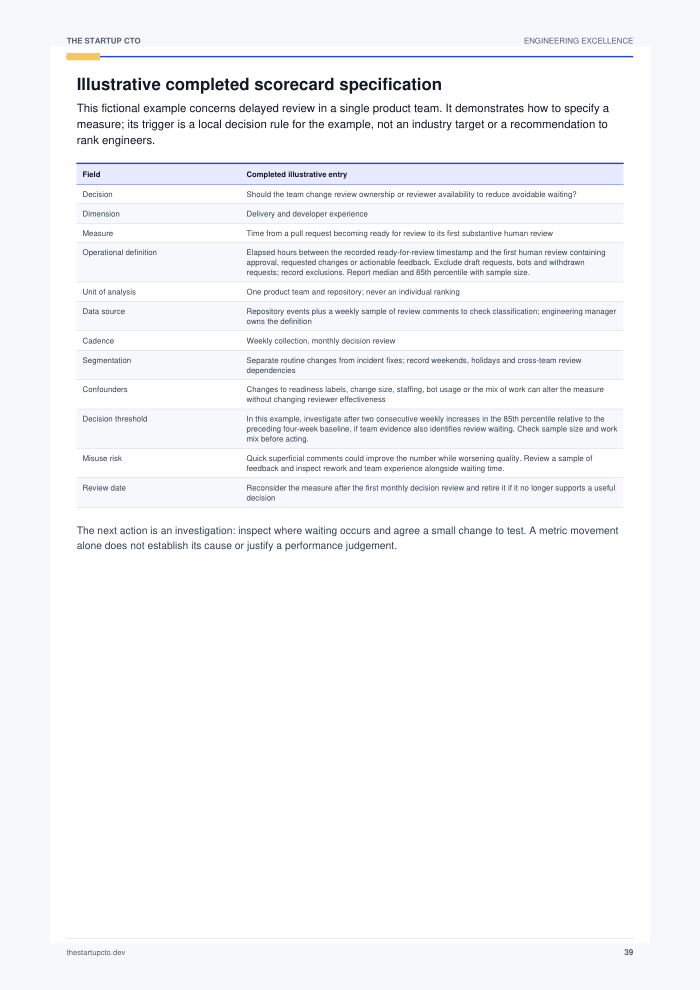
Combine telemetry with qualitative evidence. For every measure, record the question it answers, what is being measured, where the data comes from and how the result could change a decision. Note the main caveats and remove measures that stop being useful.
Retire the 10x-engineer myth.
Performance differences are real, but the early studies were small and context-specific. They did not establish that a stable type of engineer is ten times more valuable than an average peer across real work. The popular “10x engineer” label overvalues visible individual output, hides negative behaviour and encourages unsustainable heroics.
Look instead for engineers whose judgement, communication, risk management, standards and tools create disproportionate value and help other people become more capable.
Look for engineers whose judgement and communication improve the whole team.
Put the framework into practice.
Start with one organisational problem rather than rolling out a universal competency matrix. Tailor the model with real examples and test it in one decision system before applying it more widely.
- Days 1–30: define and calibrate
Choose the target problem and population, separate prerequisites from differentiators, draft observable evidence and failure signals, then test the language against recent hiring, delivery and performance examples.
- Days 31–60: pilot one decision
Use the model in a hiring loop, career conversation, performance calibration, project-allocation review or team capability assessment. Collect evidence and revise weak scoring anchors.
- Days 61–90: connect the system
Turn recurring gaps into development opportunities, review access to consequential work, establish a small balanced scorecard and publish the model with examples, owners and a review process.
You have been reading the public synthesis of Engineering Excellence: A practical framework for defining, hiring, developing, enabling, and measuring high-impact engineers. This synthesis is also available as Markdown.